The Essays of Arthur Schopenhauer
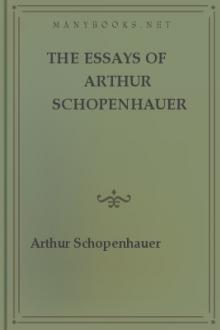
The Essays of Arthur Schopenhauer
Studies in Pessimism
 Free Download
Book Excerpt
unnatural way in which he lives, and the strain of work and emotion, lead to a degeneration of the race; and so his goal is not often reached.
The brute is much more content with mere existence than man; the plant is wholly so; and man finds satisfaction in it just in proportion as he is dull and obtuse. Accordingly, the life of the brute carries less of sorrow with it, but also less of joy, when compared with the life of man; and while this may be traced, on the one side, to freedom from the torment of care and anxiety, it is also due to the fact that hope, in any real sense, is unknown to the brute. It is thus deprived of any share in that which gives us the most and best of our joys and pleasures, the mental anticipation of a happy future, and the inspiriting play of phantasy, both of which we owe to our power of imagination. If the brute is free from care, it is also, in this sense, without hope; in either case, because its consciousness is limited to the present moment,
FREE EBOOKS AND DEALS
(view all)
















Popular books in Essays, Philosophy





More books by Arthur Schopenhauer
(view all)




Readers reviews
4.3
LoginSign up

An interesting collection of essays. They are of two types: those that attempt to expand the insight of the reader (The Sufferings of the World, The Vanity of Existence), and still provoke thought today, and those that almost codify his prejudices or those of his time (Of Women, On Noise). The latter are almost painful to read, as he makes an argument for an almost subhuman regard for women, and then explains his superior intellect over the rabble.
His essay, On Suicide, was the first I had come across that found the practice admirable.
Some of his Psychological Observations and A Few Parables were frequently banal, but overall, it was an interesting book.
His essay, On Suicide, was the first I had come across that found the practice admirable.
Some of his Psychological Observations and A Few Parables were frequently banal, but overall, it was an interesting book.
- Upvote (0)
- Downvote (0)
Arthur Schopenhauer was a German philosopher who lived from 1788-1860; he was influenced among others by Plato and Immanuel Kant, and in his turn influenced Friedrich Nietzsche, Ludwig wittgenstein, Thomas Mann and others. Schopenhauers work is known for its pessimistic views and beautifully written essays. If you like reading philosophy -or would like to try it- then I can recommend reading some of Schopenhauers essays.
This volume contains 9 essays written by Schopenhauer and translated by T.Bailey Saunders, M.A.. These essays where first published in 1851 in 'Pererga und Paralipomena'. This book includes his (in)famous essay on women, it shows a very negative view on women. I (female) found this essay very amusing, even though he did not mean it in jest and shows his hurt (I think, but this is still being discussed). This volume of essays is a very good example of Schopenhauers work: it shows how beautifully he could write, and it also shows his pessimism for which he is wellknown and which is the core of his philosophy.
The content of this volume:
ON THE SUFFERINGS OF THE WORLD
ON THE VANITY OF EXISTENCE
ON SUICIDE
IMMORTALITY: A DIALOGUE
PSYCHOLOGICAL OBSERVATIONS
ON EDUCATION
OF WOMEN
ON NOISE
A FEW PARABLES
This volume contains 9 essays written by Schopenhauer and translated by T.Bailey Saunders, M.A.. These essays where first published in 1851 in 'Pererga und Paralipomena'. This book includes his (in)famous essay on women, it shows a very negative view on women. I (female) found this essay very amusing, even though he did not mean it in jest and shows his hurt (I think, but this is still being discussed). This volume of essays is a very good example of Schopenhauers work: it shows how beautifully he could write, and it also shows his pessimism for which he is wellknown and which is the core of his philosophy.
The content of this volume:
ON THE SUFFERINGS OF THE WORLD
ON THE VANITY OF EXISTENCE
ON SUICIDE
IMMORTALITY: A DIALOGUE
PSYCHOLOGICAL OBSERVATIONS
ON EDUCATION
OF WOMEN
ON NOISE
A FEW PARABLES
07/17/2012
Oh!this god of philosophy
11/05/2006