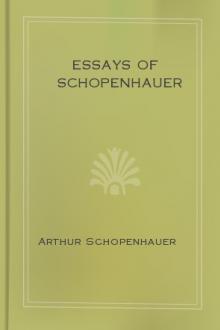
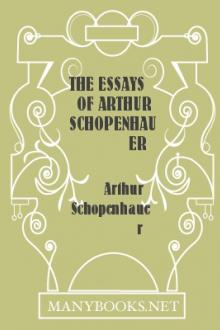
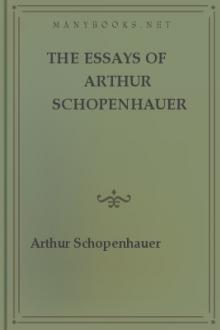
Essays of Schopenhauer
Essays of Schopenhauer
 Free Download
Although everything that Schopenhauer wrote was written more or less asevidence to support his main philosophical thesis, his unifyingphilosophical principle, the essays in this volume have an interest, ifnot altogether apart, at least of a sufficiently independent interest toenable them to be considered on their own merits, without relation tohis main idea. Translated by Mrs. Rudolf Dircks.
Book Excerpt
n, or instruction shall hear thy name and know that if Heinrich Floris Schopenhauer had not been the man he was, Arthur Schopenhauer would have been a hundred times ruined."
The year succeeding her husband's death, Johanna Schopenhauer removed with her daughter to Weimar, after having attended to the settlement of her husband's affairs, which left her in possession of a considerable income. At Weimar she devoted herself to the pursuit of literature, and held twice a week a sort of salon, which was attended by Goethe, the two Schlegels, Wieland, Heinrich Meyer, Grimm, and other literary persons of note. Her son meanwhile continued for another year at the "dead timber of the desk," when his mother, acting under the advice of her friend Fernow, consented, to his great joy, to his following his literary bent.
During the next few years we find Schopenhauer devoting himself assiduously to acquiring the equipment for a learned career; at first at the Gymnasium at Gotha, where he penned some satirical v
FREE EBOOKS AND DEALS
(view all)












Popular books in Essays, Philosophy

More books by Arthur Schopenhauer
(view all)


Readers reviews
3.0
LoginSign up

Arthur Schopenhauer was a German philosopher who lived from 1788-1860; he was influenced among others by Plato and Immanuel Kant, and in his turn influenced Friedrich Nietzsche, Ludwig wittgenstein, Thomas Mann and others. Schopenhauers work is known for its pessimistic views and beautifully written essays. If you like reading philosophy -or would like to try it- then I can recommend reading some of Schopenhauers essays.
- Upvote (0)
- Downvote (0)
Simply marvelous!
12/29/2007